Level 0 (Beginners)
Level 0+ (Advanced)
Level 1
Level 1 +(Advanced)
Students in this level should read more frequently for small and big paragraphs. Also in this level, students must know how to read from the Quran without assistance. Also, they will need to be able to write correctly. Students in this level will continue working on basic grammar. Students at the end of this level will be able to read a paragraph from a page in less than 2 minutes.
Level 2
Level 2+(Advanced)
Level 3
Level 3 +(Advance)
Quran Program
- Students will be able to recite Quran with tajweed.
- Students will be able to implement Quran in their life.
- Students will be able to critically think through explaining some parts of the Quran.
- Students will be able to read the Quran fluently with tajweed.
- Students will be able to explain the meaning of the assigned Quran text.
- Students will memorize 2-3 juza of the Quran each academic year.
Arabic Curriculums
- Iqra’ Arabic Reader
- Level one, two and three
Islamic Studies Curriculums
- Islamic Education (التربية الاسلامية) Level one, two and three.
Quran Curriculums
- Mushaaf Mujawaad chapter 30
Academic Programs & Curriculum
Building Strong Foundations in Arabic, Quran, and Islamic Character
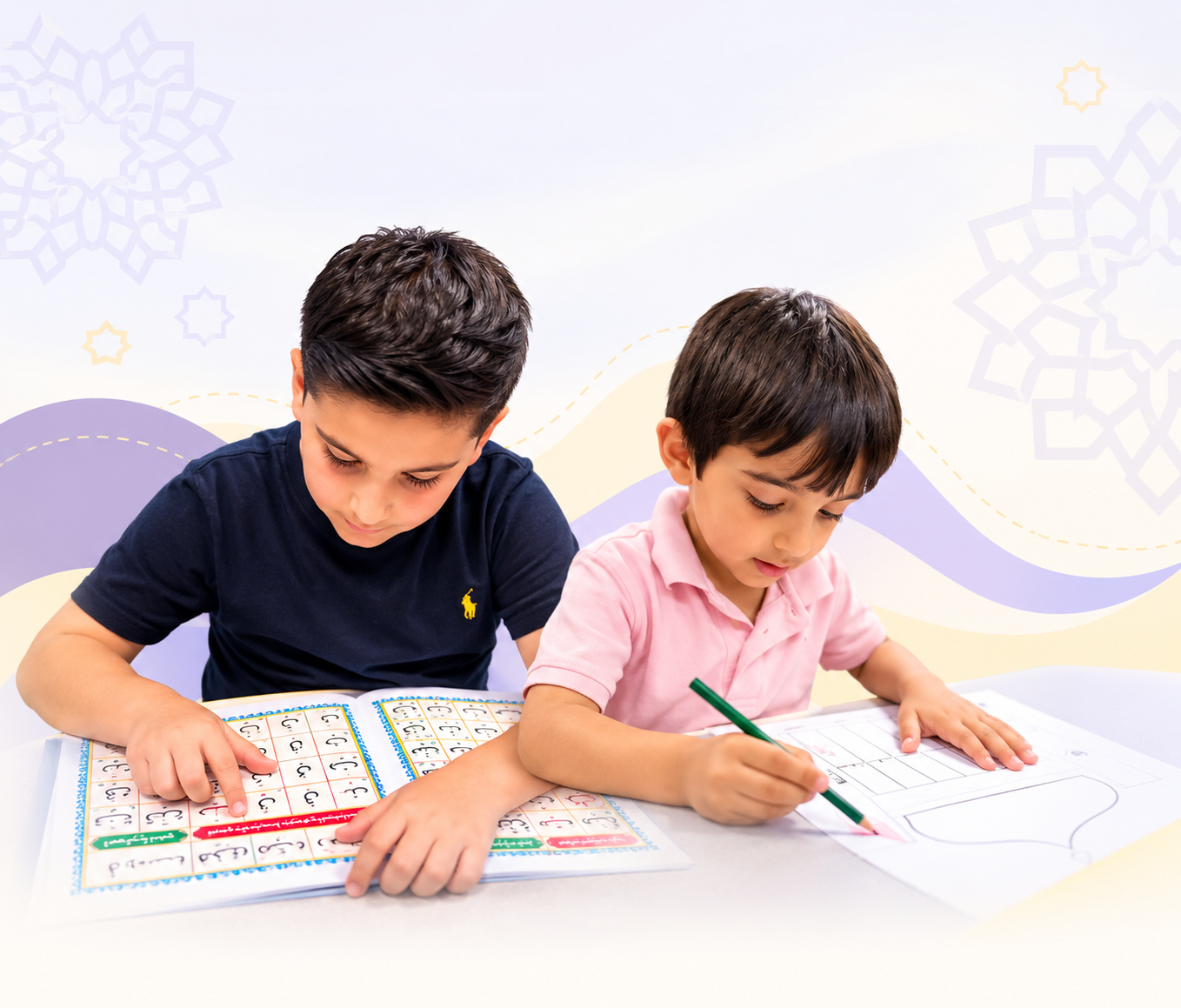
At Almadina School, our academic program is designed to help students progress confidently through structured levels of Arabic language learning, Quranic studies, and Islamic character development.
Our curriculum emphasizes reading fluency, writing proficiency, proper Quranic pronunciation, comprehension, and the practical application of Islamic values.
Students progress through Seven academic levels, from Level 0 through Level 6, including Level 0 Plus.
Arabic Language Curriculum
Level 0 | Building the Foundation
Students develop essential Arabic literacy skills through Ruwwad 1 & 2 and Al-Qaida Al-Noorania.
Learning Objectives
- Recognize, pronounce, read, and write all Arabic letters.
- Identify letter forms at the beginning, middle, and end of words.
- Recognize and apply short vowels: Fatha, Kasra, and Damma.
- Complete Noorania Lessons 1–2.
Expected Outcome: Students establish a solid foundation in Arabic letter recognition, pronunciation, and writing.
Level 0 Plus | Developing Early Reading Skills
Our Level 0 Plus program provides age-appropriate instruction for two groups.
Ages 4–8
Using Ruwwad 3 and Al-Qaida Al-Noorania, students will:
- Read and write three-letter Arabic words.
- Master short vowels, Tanween, and long vowels.
- Recognize and apply Shaddah and Sukoon.
- Identify non-connecting Arabic letters.
- Complete Noorania Lessons 4, 5, 6, 10, and 12.
Ages 8 and Above
An accelerated foundational program designed for older beginners.
Students will:
- Master Arabic letters and their different written forms.
- Complete Ruwwad 1 & 2.
- Develop reading and writing skills for three-letter words.
- Master short vowels, Tanween, long vowels, Shaddah, and Sukoon.
- Identify non-connecting Arabic letters.
- Complete Noorania Lessons 1, 2, 4, 5, 6, 8, 10, and 12.
Expected Outcome: Students develop the foundational skills needed to read and write simple Arabic words independently.
Level 1 | Reading and Sentence Development
Primary Text: Afaq 1
Students will:
- Strengthen their understanding of Shaddah and Sukoon.
- Master Lam Shamsiyyah and Lam Qamariyyah using Noor Al-Bayan.
- Connect and separate Arabic letters, words, and syllables.
- Develop fluent sentence-reading skills.
- Complete Afaq 1 Lessons 1–20 in class and Lessons 20–40 through recorded home-reading practice.
- Develop writing proficiency through Lessons 1–20.
- Complete Noorania Lessons 11, 13, 14, and 15.
Expected Outcome: Students read Arabic sentences with increasing accuracy, confidence, and independence.
Level 2 | Reading Fluency and Comprehension
Primary Text: Afaq 2
Students will:
- Read and write all assigned lessons from Afaq 2.
- Develop reading fluency, targeting completion of an assigned passage in under one minute.
- Develop an introductory understanding of Arabic pronouns.
- Master Idgham using Noor Al-Bayan.
- Complete Noorania Lesson 3.
Expected Outcome: Students demonstrate improved reading fluency, writing accuracy, and foundational grammar knowledge.
Level 3 | Advancing Arabic and Quranic Reading
Primary Text: Afaq 3
Students will:
- Read and write all lessons from Afaq 3.
- Strengthen reading fluency and comprehension.
- Review previously learned Noorania lessons and Idgham.
- Study advanced Quranic reading concepts, including Small Alif, Waw, and Ya; Letters of Leen and Madd; Iqlab and rules of Madd; and Alif Maqsurah.
- Complete the first three Quranic word-reading exercises in Noor Al-Bayan.
- Apply related Noorania Lessons 7–9, 16–17, and the final lesson.
Expected Outcome: Students demonstrate stronger Arabic literacy and apply increasingly advanced Quranic reading rules.
Level 4 | Strengthening Reading and Tajweed
Primary Text: Afaq 4
Students will:
- Read and write all lessons from Afaq 4.
- Improve reading speed, accuracy, and fluency.
- Complete the next three Quranic word-reading exercises in Noor Al-Bayan.
- Master Ikhfa using Noor Al-Bayan.
Expected Outcome: Students read Arabic passages confidently while strengthening their application of Tajweed rules.
Level 5 | Advanced Reading and Quranic Application
Primary Text: Afaq 5
Students will:
- Read and write all lessons from Afaq 5.
- Demonstrate consistent reading fluency and accuracy.
- Review and strengthen previously learned Tajweed rules, including Idgham, Iqlab, Madd, and Ikhfa.
- Complete the final four Quranic word-reading exercises in Noor Al-Bayan.
Expected Outcome: Students demonstrate advanced reading proficiency and a stronger command of essential Tajweed principles.
Level 6 | Arabic Language Proficiency
Primary Text: Afaq 6
Students will:
- Read all assigned lessons fluently and independently.
- Demonstrate proficiency in writing across the Afaq 6 curriculum.
- Strengthen reading speed, accuracy, and comprehension.
- Apply previously acquired Arabic literacy skills consistently.
Expected Outcome: Students complete the Arabic academic pathway with strong reading and writing skills, preparing them for continued Quranic and Islamic learning.
Quran Program | Connecting Hearts with the Words of Allah
Our Quran Program aims to develop a lifelong connection with the Holy Quran through proper recitation, memorization, understanding, and practical application.
Students study assigned Surahs appropriate to their academic levels, supported by instruction from Al-Qaida Al-Noorania.
Quran Curriculum by Level
Beginner Level: Al-Fatihah, Ayat Al-Kursi, An-Nas, Al-Ikhlas, Al-Falaq, Al-Kawthar, Al-Masad, Al-Asr, Quraysh.
Level 1: An-Nasr, Al-Kafirun, Al-Ma’un, Al-Fil, Al-Humazah, At-Takathur, Al-Qari’ah.
Level 2: Al-Adiyat, Az-Zalzalah, Al-Bayyinah, Al-Qadr, At-Tin, Al-Alaq, Ash-Sharh.
Level 3: Ad-Duha, Al-Layl, Ash-Shams, Al-Balad, Al-Fajr.
Level 4: Al-Ghashiyah, Al-A’la, At-Tariq, Al-Buruj, Al-Inshiqaq.
Level 5: Al-Mutaffifin, Al-Infitar, At-Takwir, Abasa, An-Nazi’at, An-Naba.
Level 6: Al-Mulk, Al-Qalam, Al-Haqqah, Al-Ma’arij.
Quran Learning Objectives
By the end of the academic year, students are expected to:
- Memorize the assigned Surahs for their level.
- Recite accurately while applying appropriate Tajweed rules.
- Understand the general meanings and lessons of the assigned Surahs.
- Demonstrate consistent progress in Quranic reading and memorization.
- Apply Quranic teachings to their daily lives.
Tarbiyah & Islamic Character Development | Learning the Quran. Living Its Values.
An important focus of our academic program is integrating Islamic character development (Tarbiyah) into everyday learning.
Through lessons inspired by the Quran and Sunnah, students are encouraged to practice:
- Respect, kindness, and compassion
- Honesty, responsibility, and trustworthiness
- Patience, gratitude, and self-discipline
- Good manners and positive communication
- Respect for parents, teachers, and the community
Our Goal
To nurture students who not only acquire Islamic knowledge but also reflect its beautiful values through their character, behavior, and everyday actions.